The Trade Remedies Authority (TRA) investigates allegations of unfair international trade practices, as well as unforeseen surges of imports, which are harming UK producers. Where there is evidence of unfair international trade practices, or unforeseen surges of imports, and evidence of injury to UK producers, the TRA recommends that a trade remedy, normally in the form of duty on imports, is put in place.
Understanding the impact of our work is important for us because it helps us to learn, change and improve how we operate. We are committed to evaluating the impact of trade remedies that the TRA has imposed, changed or revoked in recent years.
Impact evaluation is a systematic assessment of outcomes, intended or unintended, of an intervention. Impact evaluation aims to determine if these outcomes can be attributed to an intervention or if they would have happened by pure chance.
How we are evaluating trade remedies: which measures, which data, which methods
To get started on exploring the impact of trade remedies, we chose a small number of our trade remedy measures including new UK measures as well as EU measures that have been reviewed as part of transition reviews.
We used UK imports data from January 2017 to September 2024 from the Overseas Trade in Goods Statistics dataset from uktradeinfo. We looked at data on UK imports of affected goods from countries covered by our measures, imports of unaffected but similar goods from third countries and imports of other unaffected goods from countries covered by our measures and third countries.
Previous research commissioned by the TRA identified feasible and suitable econometric methods for impact evaluation. We have employed two methods so far: the difference-in-differences (diff-in-diff) model and the Synthetic Control Method (SCM) model. The diff-in-diff model and SCM model have previously been used in academic and policy literature to study trade effects of policy changes, including trade remedies.
Both diff-in-diff and SCM assess the impact of a policy by comparing an outcome of a treated group (affected by the policy) with an outcome of an untreated or control group (not affected), before and after the policy change. Diff-in-diff requires the analyst to manually identify a suitable control group, while SCM uses data optimisation to build a synthetic control group. In both cases, the method is considered reliable if the treated group and the untreated group have similar outcomes before the policy change.
Our initial analysis based on the data available for most part has not yet identified a statistically significant effect on UK imports from the imposition, change or revocation of dumping or subsidy measures. This could be explained by a number of factors, including limitations of the data available. For example, UK imports data currently only cover a small number of years of the ‘post-intervention period’, i.e. time period since our measures were transitioned, imposed, changed or revoked.
UK imports data are also reported at country-level and commodity-level but are not reported at firm-level.
How can we make sense of complexity in impact evaluation of trade remedies?
Evaluating the economic impact of trade remedies is a complex task. To the best of our knowledge, while trade remedy investigating authorities in other countries do produce reports and/or summary data related to their activities, which feed into data reported by the World Trade Organization (WTO) such as semi-annual reports on anti-dumping and countervailing actions, few have made an attempt to evaluate the impacts of their measures.
Let’s walk through the complexity of the task ahead of us based on an example: red candles being imported from Wickland.
Economic theory would suggest that if there were a UK trade remedy imposed on red candles imported from Wickland, UK imports of red candles from Wickland would decrease. This is because red candles from Wickland would become relatively more expensive compared to red candles from the UK, white candles from Wickland, or white candles from the UK candles from the UK.
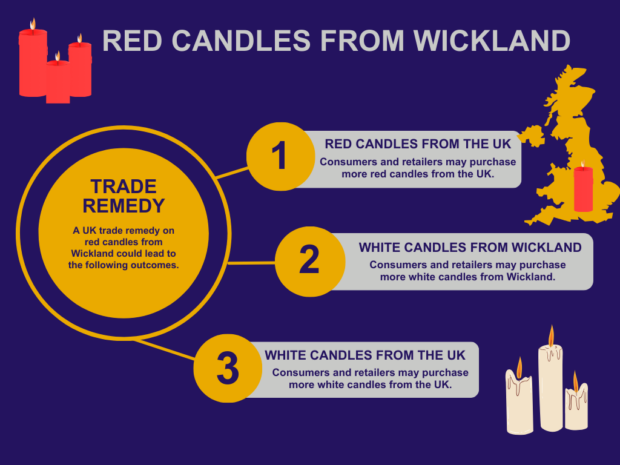
In practice, however, the link between the UK trade remedy on red candles imported from Wickland on the one hand and the size of UK imports of red candles from Wickland on the other hand may not be this easy to see in the trade data.
Firstly, trade remedies are often firm-specific. This means red candles imported from a company called Starlit Candles in Wickland may be subject to a different level of duty compared to red candles imported from a company called Moonlit Candles in Wickland. It is possible that UK importers would start to buy more red candles from Moonlit Candles and buy fewer red candles from Starlit Candles, which results in no overall change in the size of UK imports of red candles from Wickland.
Secondly, overseas exporters could also absorb the cost of trade remedies in the UK by continuing to export and by lowering their export prices in an attempt to maintain sales volumes and market shares in the UK. In such a situation, if evidence to corroborate it was either to be submitted by UK industry to the TRA or if such evidence was available to the TRA, the TRA would then consider initiating an absorption review.
Thirdly, econometric methods often used for impact evaluation assume that everything is operating ‘other things being equal’ (i.e. ‘ceteris paribus’). To have the best chance of evaluating the impact of trade remedies on UK imports, production or employment, we would ideally want nothing else to change that then affects UK trade, production or employment. But we know that in reality, economies are dynamic and constantly changing, with multiple drivers that could potentially affect UK trade, production or employment independently of trade remedies.
Lastly, there is also the complexity arising from changing behaviour of firms and/or consumers. Econometric methods used in impact evaluation work best if there are no anticipation effects, no substitution effects, no complementarity effects, which is difficult to achieve in practice. Firms could anticipate and change the way of doing business before any change to trade remedies that could affect them coming into force (i.e. ‘anticipation effects’).
Firms could also change a product mix, what they buy and from where, as a result of any change to trade remedies coming into force (i.e. ‘substitution effects’ and ‘complementarity effects’), which makes it harder to identify a suitable control group or build a synthetic control group that is not affected by change to trade remedies. Econometric methods’ blindness to these assumptions makes it difficult to conclude that there is an effect or no effect of trade remedies.
Concluding thoughts and next steps
As time progresses, we will have more years of data to use in our impact evaluation, increasing the likelihood that what we observe in the data are medium- to long-term trends that could be attributed to changes to trade remedies rather than any short-term trends. Our future impact evaluation will look at other case studies, especially now that we have built our TRA imports dashboard, which will assist with monitoring and evaluation.
If you have any questions about the TRA’s work on evaluation, please do get in touch with us: statistics@traderemedies.gov.uk.
Leave a comment